The idea of painting a landscape across several panels came from Hampton Court, where Mantegna’s Triumphs of Caesar run as nine separate canvases along the walls. You can’t take them in all at once. You move along them a section at a time, and the picture builds as you go. I wanted a landscape that worked in a similar way.
The triptych also has a long history as an altarpiece, something you stand in front of in order to look past the everyday. That suited what I was after. For me, woods and water have always been about more than what’s physically there. It’s a spiritual feeling rather than a religious one: the sense that a place at dusk can be an experience, not just a view.
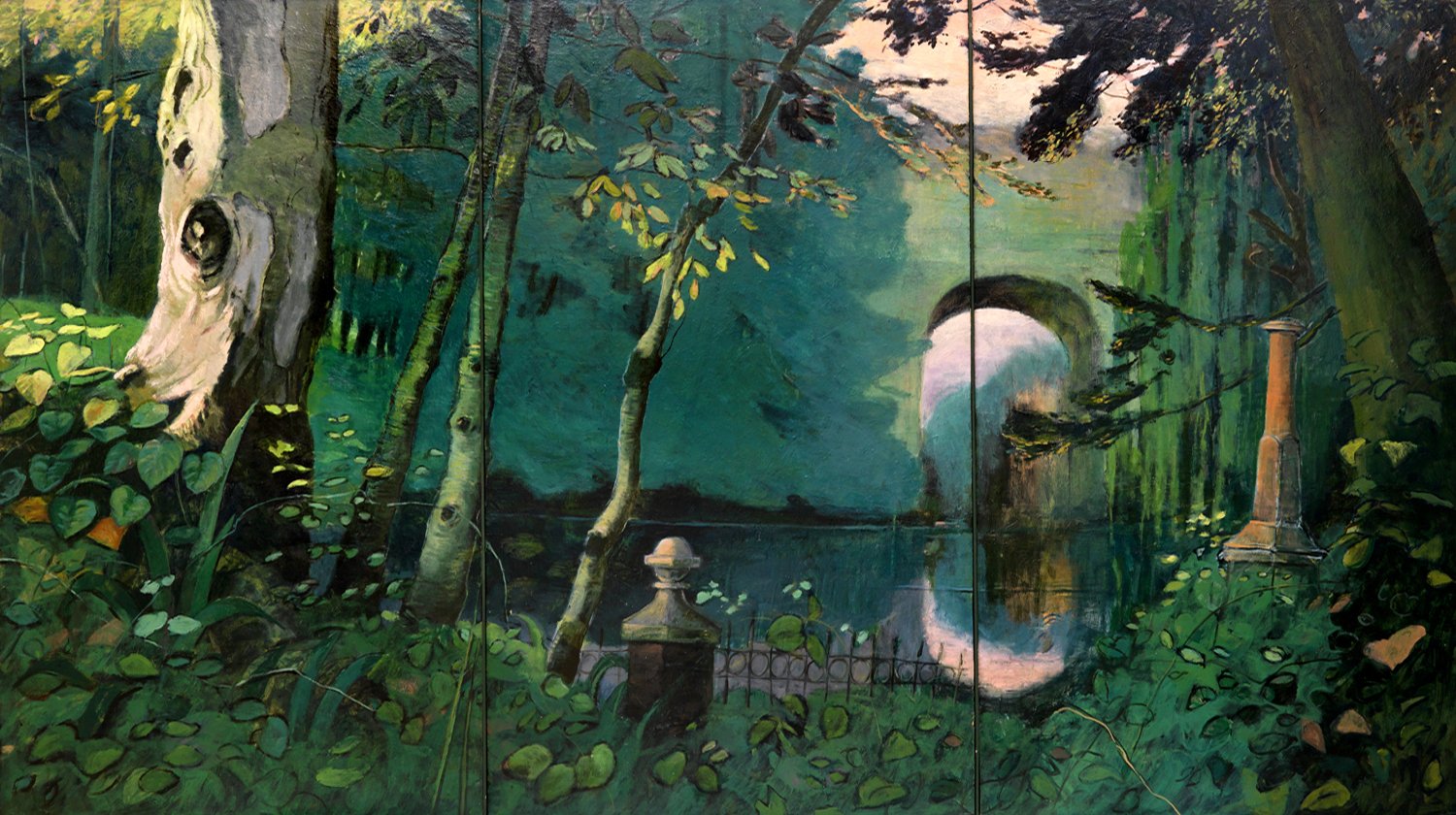
Archway and River at Dusk is full of signs of people, yet there are no people in it. There’s a gatepost with a ball on top, a run of old iron railing, and a column standing alone in the undergrowth. These came from things I’d noticed on old buildings. They don’t carry hidden meanings. They’re there to suggest that someone has been here, and that this was once a tended place, slowly being taken back by the woods.
The arch is different. It comes from the old viaduct on the Teme in Shropshire, which I’ve drawn and painted many times and keep returning to. Here it becomes more than a viaduct. You can read it as a bridge, or as a doorway through to somewhere else, a place beyond. With the last light passing through it and its reflection held in the river below, it’s the point the whole painting turns on.
The viaduct, and this way of working, go back much further than this painting. In 1992 I was on my foundation year at Shrewsbury College of Art and Technology, where Peter Bishop, my tutor and later a mentor long after art school, introduced me to the idea of a landscape beyond topography: a painting of a place that does more than describe it. He showed me this through Christopher Lebrun’s work and through his own landscapes, and it has stayed with me ever since.
After that, it was mostly solo exhibitions that kept the work moving. Each show pushed me to make a run of new images around a theme, and the viaduct kept coming back. Archway and River at Dusk came out of that in 2003, and Mortimer Lake at Dusk followed years later from the same source. Neither is a record of one spot. Both are built from real places and real objects, then brought together into somewhere that only exists in the painting.
Archway and River at Dusk, oil on panel, triptych, 127 x 226cm, 2003. Read how Mortimer Lake at Dusk came about.